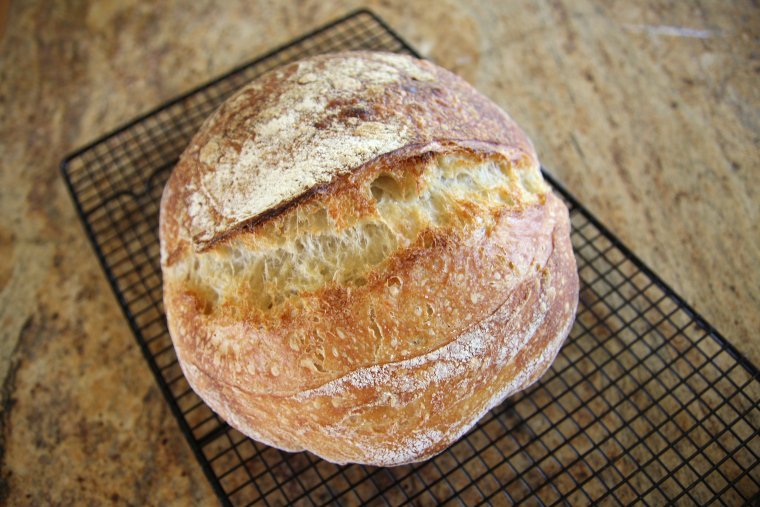
Long-Fermented Artisan Sourdough Bread
Long-Fermented Artisan Sourdough Bread - Recipes
Servings1
Plan it in the app to put it on your week.
- Vegetarian
- Vegan
- Dairy Free
- Pescatarian
- Halal
- Egg Free
Steps
- 1(11am on day 1) Feed sourdough starter and set aside. Tare out your kitchen scale with a large bowl on top and weigh out your flour. Tare out your scale and slowly add the correct amount of ice water. Mix flour and water together until all the dry flour is absorbed. (Refer to photo in blog post. If your dough is more slack than mine, mix in a sprinkle more flour. Every brand of flour is different.) Cover bowl with a lid and refrigerate for 6 hours.
- 2(5pm on day 1) Weigh out salt and sprinkle over dough. At this point your starter should be active and bubbly (almost foamy). Weigh out 150 grams of starter. Add starter to your dough over your salt. Use your fingers to poke the starter into the dough. Squeeze and work the dough until it comes back together.
- 3(5:10pm-9:10pm on day 1) Wet your fingers so they don't stick to the dough. Slide your fingers underneath the dough, pull the dough gently upwards, and then fold it over itself to the opposite side of the bowl. This is called a "stretch-and-fold." Turn your bowl slightly, and do another stretch-and-fold. Turn the bowl again and do one more. Cover your dough loosely with your lid and let it rest on the counter for 30 minutes (or in your oven with the light on if your house is less than 72°F). Repeat this process for two more sets of stretch-and-folds spaced 30 minutes apart. Then let your dough rest for the remainder of the 4 hours (or longer) until dough has risen by 1/3 its volume. Place the lid on your dough and refrigerate until the morning of day 3.
- 4(9am on day 3) Dust your counter with flour and use a dough scraper to gently encourage the dough out of the bowl in one mass. Don't deflate the dough. Pull the edges of the dough onto itself to form a ball shape. Flip it over gently and place on your counter in an area with no flour. Cup your hands around the top of the ball and gently pull the dough a couple inches toward yourself against the countertop. Give the ball a quarter turn and pull against the counter toward yourself again. Gently pop any large air bubbles that appear on the surface of your loaf. Repeat until the skin on the top of the loaf is smooth and tight. Don't go too far, though, or the surface will begin to tear. Cover your loaf with a flour sack towel and let it rest for 10 minutes. Flip your dough top side down, and repeat the shaping process one more time: ends in, flip over, pull against the counter to tighten the skin.
- 5Use a fine mesh strainer to generously flour your banneton or a bowl lined with a flour sack towel (rice flour works best). Place your boule top side down in the banneton. Cover again with a flour sack towel and let it proof (rise) for 1-2 hours or until it passes the poke test (in the oven with the light on, if needed).
- 6When proofing is almost done, preheat your oven to 475°F (make sure dough isn't in there) and then place your Dutch oven in the oven to preheat for 10 minutes.
- 7Place a large square of parchment paper on your countertop. Dust your loaf with flour or semolina flour and gently invert your loaf onto your parchment paper. Rub any excess flour on the top of your loaf around to evenly distribute it. Trim the excess parchment paper from around your loaf leaving only enough to grab onto. Remove your Dutch oven from the oven and open the lid. Use a lame or razor blade to slash your loaf. Transfer the loaf into the Dutch oven, cover with the lid, and bake for 20 minutes. After 20 minutes, lower the temperature to 450° and remove the lid. Continue to bake until your loaf is a deep golden color. Remove to a cooling rack and allow it to cool completely before slicing.
Nutrition
- Calories
- 1817kcal
- Protein
- 51g
- Carbs
- 384g
- Fat
- 5g
- Fiber
- 13g
- Sugar
- 1g
Estimated from the ingredient list.
Make it yours
Swap ingredients, change amounts, and keep your own copy. The original stays exactly as it is.
Questions
How long does long-fermented artisan sourdough bread take to make?
About 0 minutes from start to finish, including prep.
How many people does this recipe serve?
It serves 1 as written. Use the servings control to scale every ingredient up or down.
Can I change the ingredients?
Yes — in the Zaki app you can make this recipe yours: swap ingredients, change amounts, and keep your own copy. The original stays as it is.